
Should you straighten your teeth before veneers?
If your front teeth are crowded, worn or uneven, veneers are often the first treatment people ask about. They are not always the first treatment they should have. Moving the teeth into a better position first can mean less natural enamel removed, fewer teeth needing porcelain at all, and a result built on teeth that sit where they should.
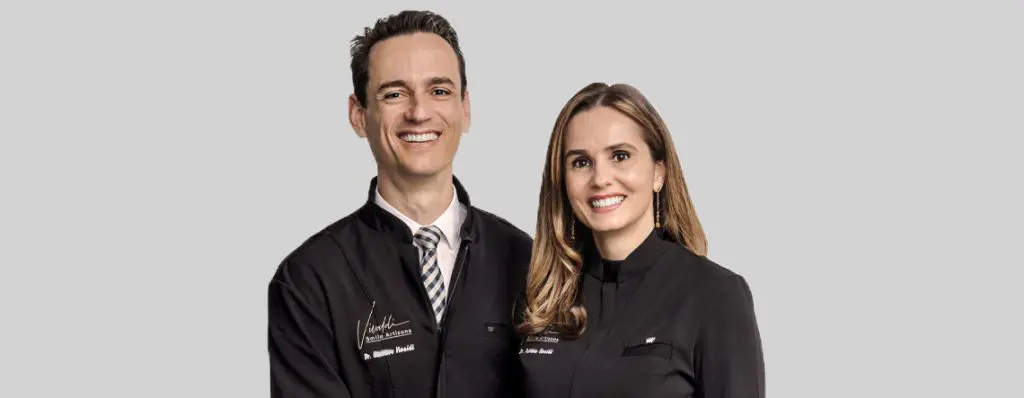
At Vivaldi Smile Artisans in Sydney CBD, that decision is made by two clinicians together: Dr Patricia Vivaldi, who plans the final restorative result, and Dr Gustavo Vivaldi, a Diamond Invisalign Provider with 24+ years of orthodontic experience, who determines whether moving the teeth gets there with less intervention.
The question veneers alone cannot answer
A veneer changes the surface of a tooth. It cannot change where the tooth sits, how it meets the tooth opposite, or how much of it has to be cut away to make a crooked tooth look straight.
When a tooth is rotated or pushed back, making it look aligned with porcelain means removing enough enamel to bring the new surface into line with its neighbours. The more out of position the tooth is, the more enamel goes, and enamel does not grow back. Over a working lifetime, a veneer on a heavily prepared tooth is more likely to need replacing, and the tooth beneath it has fewer options each time.
Moving that tooth first changes the arithmetic. Once it sits where it should, a veneer, if it is still needed, can be thin and conservative. Some teeth will not need one at all. The finished smile looks natural because it is built on natural positions, not disguised ones.
This is not a new idea, and it is not ours alone. It is simply the question that has to be asked before anything irreversible is done, and it needs an orthodontic clinician in the room to answer it properly.
When straightening first makes sense
Dr Patricia and Dr Vivaldi look at the same scan and ask two different questions. Dr Patricia asks what the finished smile should look like and which teeth genuinely need restoring. Dr Vivaldi asks whether moving the teeth would let that result be achieved with less porcelain and less preparation. Straightening first is usually worth considering when:- Old veneers are failing on crowded teeth. Replacing them like-for-like repeats the original compromise. Aligning first can mean the replacements are thinner, or fewer.
- One or two teeth are rotated or set back. Masking a single rotated tooth with porcelain costs that tooth a lot of enamel. Moving it is kinder.
- The bite is part of the problem. Worn or chipped front teeth are often worn because of how they meet. New veneers on an uncorrected bite wear the same way.
- You would rather keep natural teeth natural. Composite bonding or teeth whitening after alignment can finish a smile that would otherwise have been veneered edge to edge.

Why two clinicians, not one
Many cosmetic practices in Sydney offer aligners alongside veneers, and some make the case for straightening first. Most offer aligners for mild to moderate crowding, and refer rotations, larger movements and bite corrections elsewhere.
That matters for exactly the cases where straightening first has the most to offer. The tooth that would cost the most enamel to mask is often the one that needs the most movement.
Dr Gustavo Vivaldi has provided orthodontic treatment for more than 24 years and is a Diamond Invisalign Provider. He treats with Invisalign, Angel Aligners, metal and ceramic braces, and LightForce 3D-printed braces, so the movement is planned by the clinician who will carry it out.
Dr Vivaldi plans and carries out all orthodontic treatment himself, across the full range of cases: aligner cases, cases that need braces, and cases where the bite problem lies in the jaws and orthodontics is combined with jaw surgery. In those, he provides the orthodontic treatment before and after surgery and works with an oral and maxillofacial surgeon on the surgical phase. Orthodontic treatment is never referred to another practice, and the restorative plan does not wait for a report from elsewhere.
Dr Patricia Vivaldi plans and places the restorative work: composite bonding, composite and porcelain veneers, and single-visit CEREC crowns. She sets the endpoint before orthodontics begins, so the teeth are moved to where the final design needs them, not merely into a straighter line.
What the combined plan costs
We publish pricing for both halves so you can see the whole picture before you book. Every figure is all-inclusive or per tooth as stated, and your written quote at consultation confirms your exact case.Orthodontic phase (Dr Vivaldi)
- Invisalign or Angel Aligners: $4,000 to $11,000, all-inclusive (aligners, all appointments, remote monitoring, refinements and retainers)
- Metal, ceramic or LightForce braces: $4,500 to $11,000, all-inclusive
- Limited or front-teeth-only movement, where suitable, sits at the lower end of these ranges
- Interest-free in-house plans from $70 per week (see orthodontic cost and finance)
Restorative phase (Dr Patricia)
- Composite bonding: $410 to $600 per tooth
- Composite veneers: around $780 per tooth
- Porcelain veneers: around $2,100 per tooth (six around $12,600, eight around $16,800); see our veneers cost in Sydney guide
- Teeth whitening, if it finishes the plan instead of veneers: take-home $450, in-chair from $790, Zoom $910
- CEREC crown, where a tooth needs full coverage: $2,200
A plan that aligns first and then bonds or whitens often costs less in total than replacing a full set of porcelain, and leaves more natural tooth. A plan that aligns first and then places fewer, thinner porcelain veneers costs about the same as veneers alone and preserves more of your natural teeth for the future. Dr Patricia sets out both options in writing with the numbers for your case.
How the planning works
- Cosmetic consultation with Dr Patricia. Photographs, an iTero 3D scan, and a conversation about what you want the finished result to look like. She identifies which teeth genuinely need restoring and which could be left natural.
- Orthodontic assessment with Dr Vivaldi. He reviews the same scan and advises whether movement would reduce the preparation needed, which appliance suits the case, and how long the orthodontic phase would take. Where the answer is that veneers alone are the better route, he says so.
- One written plan. Sequence, timing, and the cost of each phase, so you can decide with the whole picture in front of you. Nothing irreversible happens before you have agreed to it.
- Orthodontic phase. With remote monitoring included, in-practice visits are typically every six to ten weeks rather than every month; most aligner and braces plans run 9 to 18 months depending on the movement required.
- Restorative phase. Bonding, veneers or whitening placed once the teeth are stable, followed by retainers (included) to hold the position that the restorations were designed around.
If you are already certain alignment is part of your plan, adults can start with a free 30-minute orthodontic smile assessment instead, and Dr Patricia joins the planning from there.
Straightening before veneers: frequently asked questions
Often, yes. If the teeth are crowded, rotated or set back, moving them first means a veneer can be thinner, or not needed at all, and less natural enamel is removed. Where the teeth are already well positioned and the concern is colour or shape, veneers alone may be the right answer. At Vivaldi Smile Artisans, Dr Patricia Vivaldi and Dr Gustavo Vivaldi review the same scan and recommend the sequence for your case.
Not necessarily. Old veneers were placed on the tooth positions you had at the time. If those teeth are crowded or have drifted, replacing like-for-like repeats the original compromise. Aligning first can mean the replacement veneers are thinner or fewer, and some teeth may be suitable for composite bonding instead. Dr Patricia assesses why the previous veneers failed before planning the replacements.
At Vivaldi Smile Artisans, the orthodontic phase is $4,000 to $11,000 for Invisalign or Angel Aligners and $4,500 to $11,000 for braces, all-inclusive. The restorative phase is priced per tooth: composite bonding $410 to $600, composite veneers around $780, porcelain veneers around $2,100. Limited front-teeth movement sits at the lower end of the orthodontic range. Your written quote confirms the exact figures.
Most cases, yes, and where aligners alone cannot, braces or LightForce 3D-printed braces can. Dr Vivaldi provides all of these, so cases that need more than aligners are planned and treated here. The appliance is chosen for the movement required and desired outcomes, not the other way round.
The orthodontic phase typically runs 6 to 18 months depending on the movement required, with remote monitoring reducing in-practice visits. Bonding or whitening is usually completed in one visit afterwards; porcelain veneers take two to three visits. Dr Patricia gives you a timeline for your case at consultation.
Yes. Teeth drift back without retention, and the restorations are designed around the aligned positions. Retainers are included with every orthodontic treatment at Vivaldi Smile Artisans, and Dr Vivaldi advises on long-term retention as part of the plan.
No referral is needed. If you are unsure whether alignment is part of your plan, book a cosmetic consultation with Dr Patricia and both clinicians review your scan. If you already know you want to straighten first, adults can begin with a free 30-minute orthodontic smile assessment.
Plan both parts before either begins
The most useful decision in a smile reconstruction is often what not to restore. Book a cosmetic consultation at 161 Clarence Street, Sydney CBD, and both clinicians will review your scan before anything irreversible is planned. Pricing for every phase is published above and confirmed in writing.